

















Marvin

Nano Banana vs FLUX Kontext Max: Which AI Generator is Better?

This article is a technical analysis of Google Nano Banana and FLUX Kontext Max, two most talked-about model in AI image generation and editing. I will compare them in detail to guide your choice.

Try for Free
A banner picture that shows the comparison of nano banana and flux kontext max

The AI image editing scene heated up after Google unveiled Gemini Flash Image on the 26th of this month, instantly winning user attention.

Riding this wave, Google followed with the Nano Banana AI generator. This is another ambitious step in context-aware editing and identity preservation. At the same time, many creators have turned to FLUX Kontext Max, a model known for its workflow efficiency and commercial stability.

In this blog, I'll provide a comprehensive, detailed analysis of the two models' technical performance, practical applications, target users, pricing models, and limitations.

⭐At a Glance:

If you want maximum editing flexibility, go with FLUX Kontext Max; if you prefer quick, straightforward results, Nano Banana is the better pick.
Understanding Nano Banana and FLUX Kontext Max

From Google’s research labs to Black Forest’s breakthroughs, Nano Banana and FLUX Kontext Max showcase distinct innovations that are reshaping how we generate and edit images.

What is Nano Banana?

Nano Banana, unveiled by Google on August 26th, is a cutting-edge AI model designed for image generation and editing. It excels in context-aware image editing. In other words, users provide text prompts or reference images, and this model adjusts elements while preserving overall coherence and visual consistency.

What Users are Saying:

“Nano Banana is the first image generator that can do image consistency with real photos.” — Reddit comment

“The Internet isn’t ready for it—Nano Banana AI is the next big leap in creative tools.” — Instagram comment

“The Tweet that sparked a frenzy... within hours, searches for ‘nano banana’ skyrocketed. Google Trends went wild.” — Medium

What is FLUX Kontext Max?

FLUX Kontext Max, released by Black Forest Labs on May 29th, is a powerful AI model for image generation and editing. It stands out with character consistency and local editing capabilities. That means users can modify specific areas of an image while keeping the main subject’s appearance consistent across multiple edits.

What Users are Saying:

“Flux Kontext Max Multi Image is insane!!” — X (Twitter) comment

“Most AI tools? They mess that up. But Flux Kontext? It nails it. Every time.” — Instagram comment

“It’s basically AI Photoshop. It’s great at changing specific things without making a whole new image or changing around the details.” — Reddit comment

Performance Snapshot of the Two Models

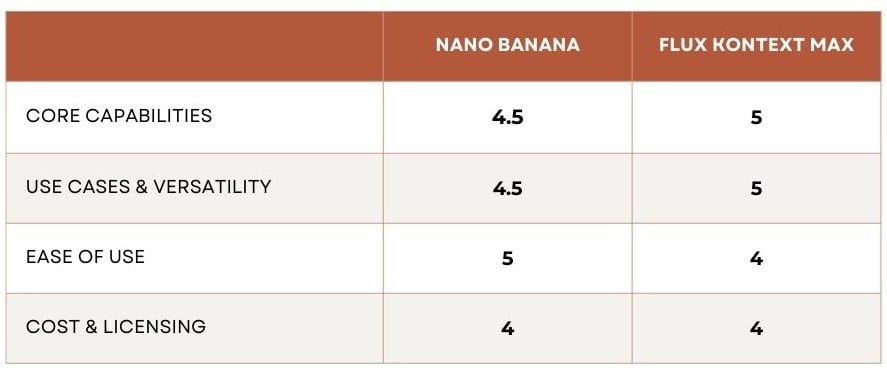
Before diving into technical details, here’s a scorecard that highlights how both models perform.

FLUX Kontext Max stands out in core capabilities and versatility. Nano Banana excels in ease of use. As for the pricing plan and commercial licensing, they reach a tie.


Performance Comparison: Google Nano Banana vs FLUX Kontext Max

In the last section, we introduced a scoring system. Now, let’s see how the two models actually perform.

To make the differences more tangible, we’ll first show a radar chart that compares their strengths side by side. After that, we’ll go through nine important areas for feature-by-feature comparison.

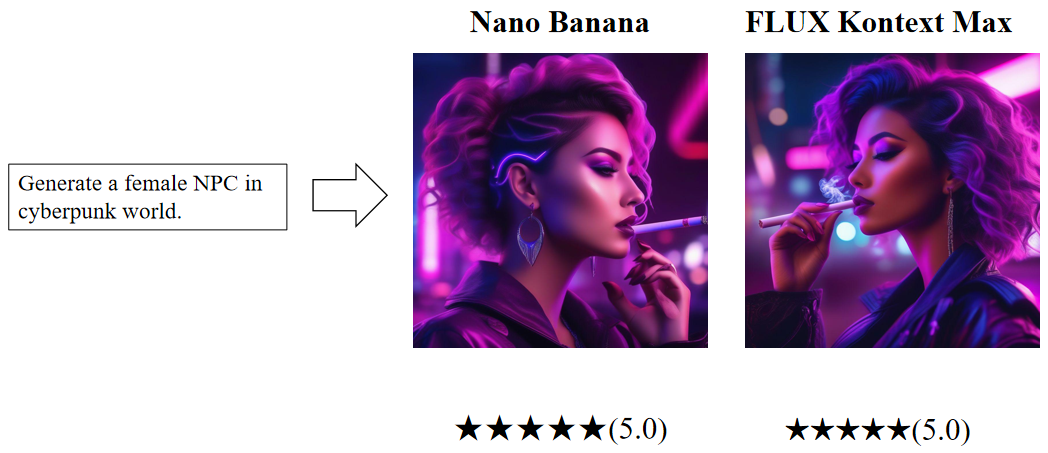
1. Language-Driven Editing

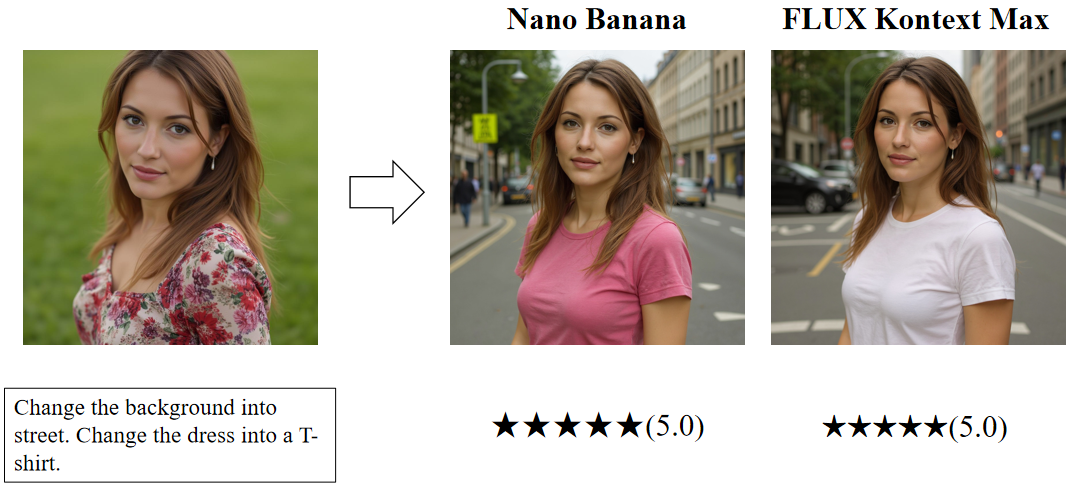
Nano Banana: ★★★★★(5.0)

FLUX Kontext Max: ★★★★★(5.0)

How they work:

  • Nano Banana feels conversational for natural-language edits. And FLUX Kontext Max is precise and command-driven. So it’s a tie.
  • Nano Banana makes editing feel like a conversation. You can describe what you want in plain language, and it applies the changes directly.
  • Flux Kontext Max works more like a text-to-image generation and editing tool. It’s precise and command-driven, giving you fine control.

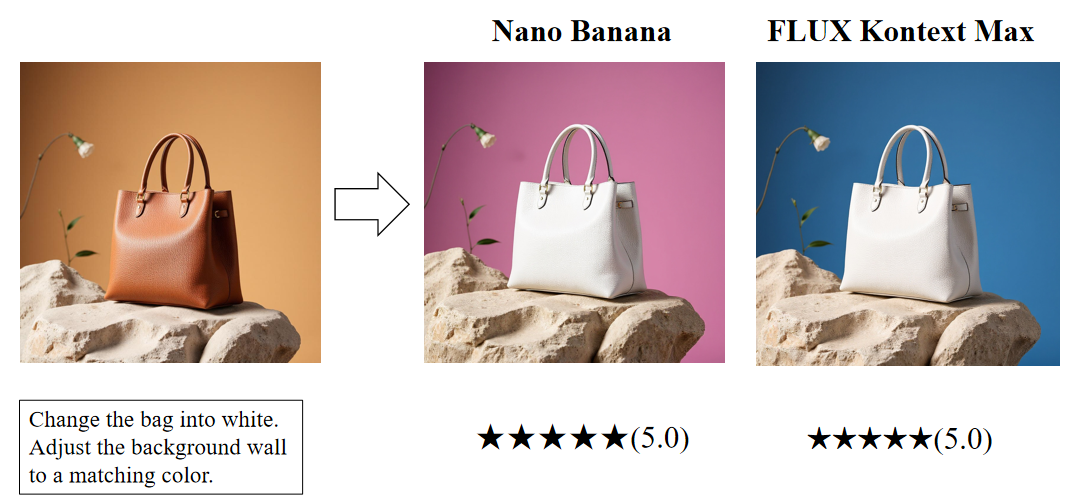
Real test:

  • Outfit and background swaps

Both models are great when you want to change someone’s clothes or drop them into a new scene. The edits look natural, and the person still looks like themselves.

2. Visual Storytelling & Style Reference

Nano Banana: ★★★★★(5.0)

FLUX Kontext Max: ★★★★★(5.0)

How they work:

  • Nano Banana creates smooth storytelling across images. And FLUX Kontext Max ensures consistent style at scale. So it’s a tie.
  • Nano Banana AI generator creates smooth storytelling across multiple images, maintaining continuity and photorealistic output quality.
  • FLUX Kontext Max stands out for style reference at scale, making sure visuals stay consistent across large or complex projects.

Real test:

  • Game asset design

Both models are good at building game characters and environments. Once you set a specific style, they can generate entire sets of game assets.

3. Speed & Commercial Stability

Nano Banana: ★★★★★(5.0)

FLUX Kontext Max: ★★★★★(5.0)

How they work:

  • Nano Banana delivers rapid edits without sacrificing quality. And FLUX Kontext Max emphasizes stable reliability. So it’s a tie.
  • Nano Banana AI generator offers rapid text-to-image generation and editing without losing photorealistic output quality.
  • FLUX Kontext Max focuses on workflow efficiency and long-term viability, delivering stable results that hold up over time.

Real test:

  • E-commerce product visualization

Both tools are fast and reliable. With just one source photo, they can create multiple styled shots like beach vibes, holiday setups, or studio clean looks.

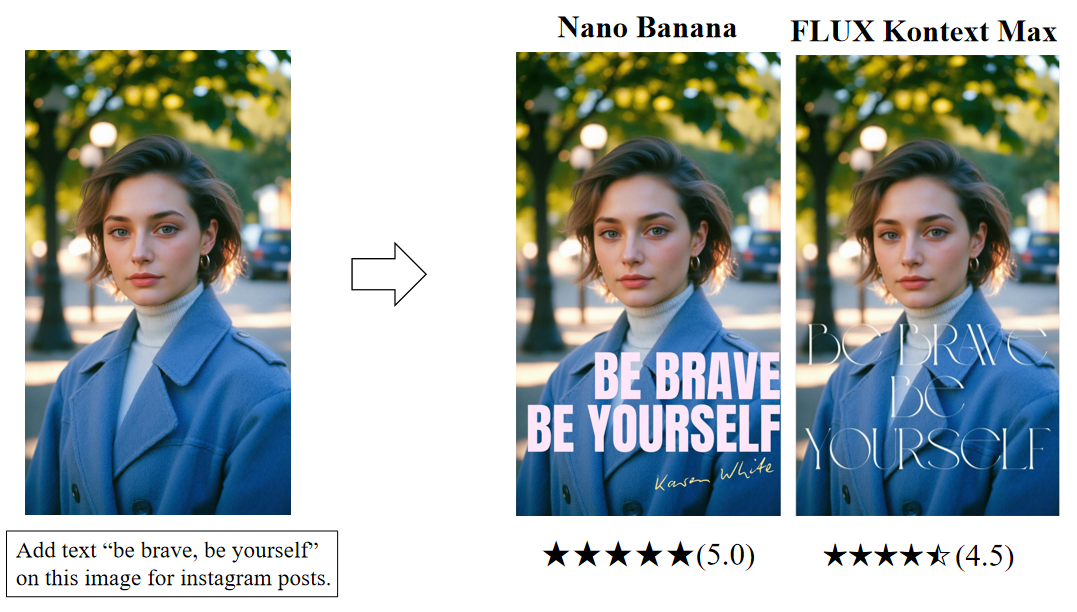
4. Multimodal Comprehension (Image + Text)

Nano Banana: ★★★★★(5.0)

FLUX Kontext Max: ★★★★⯪(4.5)

How they work:

  • Nano Banana stands out with greater accuracy. But FLUX Kontext Max struggles with highly detailed prompts. So Nano Banana is better.
  • Thanks to Google’s research edge, Nano Banana shines when combining natural language understanding with visual context.
  • FLUX Kontext Max also performs well but shows small gaps with highly detailed multimodal prompts.

Real test:

  • Social media posts

The two models understand both the picture and your text description, generating posts that combine an image with a caption or tagline. But Nano Banana works slightly better.

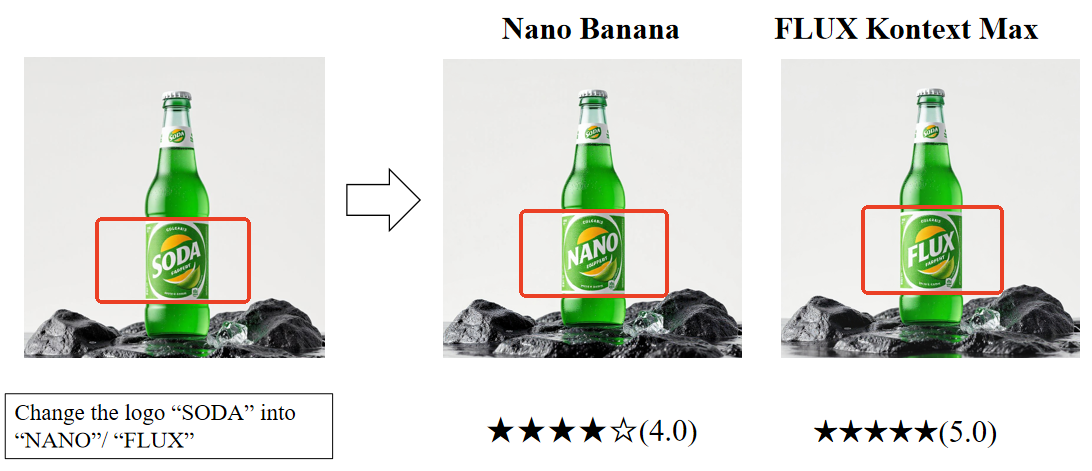
5. Local Editing Precision

Nano Banana: ★★★★☆(4.0)

FLUX Kontext Max: ★★★★★(5.0)

How they work:

  • Nano Banana is better suited for broader workflow tasks. But FLUX Kontext Max offers precise control. So FLUX Kontext Max is better.
  • Google Nano Banana AI generator supports local editing, but its strength is in bigger-picture tasks like workflow efficiency rather than pixel-perfect edits.
  • FLUX Kontext Max is built for fine control. It lets you adjust very specific parts of an image without disturbing the rest.

Real test:

  • Advertisement touch-ups

When updating visuals, sometimes you only want to make minor adjustments like changing a product logo or fixing a background detail. FLUX Kontext Max does better in this use case.

6. Character Consistency

Nano Banana: ★★★★★(5.0)

FLUX Kontext Max: ★★★★⯪(4.5)

How they work:

  • Nano Banana excels at preserving identity and character consistency. But FLUX Kontext Max struggles with fine details. So Nano Banana is better.
  • Google Nano Banana AI generator is especially strong in identity preservation and character consistency, keeping faces and figures steady across multiple images.
  • FLUX Kontext Max is solid too but sometimes slips on smaller details.

Real test:

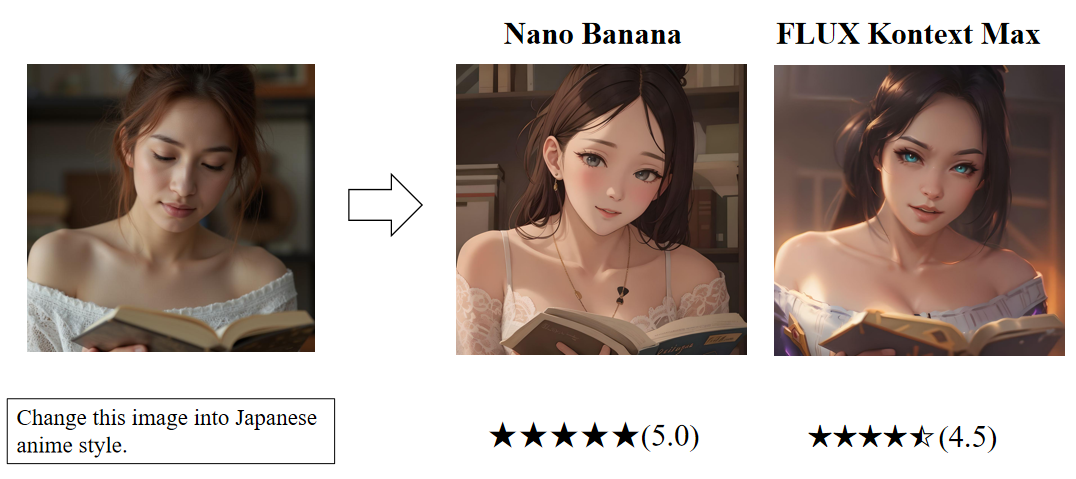
  • Style change

When it comes to style change, the challenge is to make sure the model still looks like the same person across different styles. Both models perform reliably but Nano Banana works slightly better.

7. Typography

Nano Banana: ★★★☆☆(3.0)

FLUX Kontext Max: ★★★★★(5.0)

How they work:

  • Nano Banana is limited in typography handling, while FLUX Kontext Max excels at text layout. So FLUX Kontext Max is better.
  • Google Nano Banana AI generator is more limited when it comes to typography.
  • FLUX Kontext Max dominates in text-to-image generation. It's a leader in editing precise text layout, ensuring clarity and style consistency.

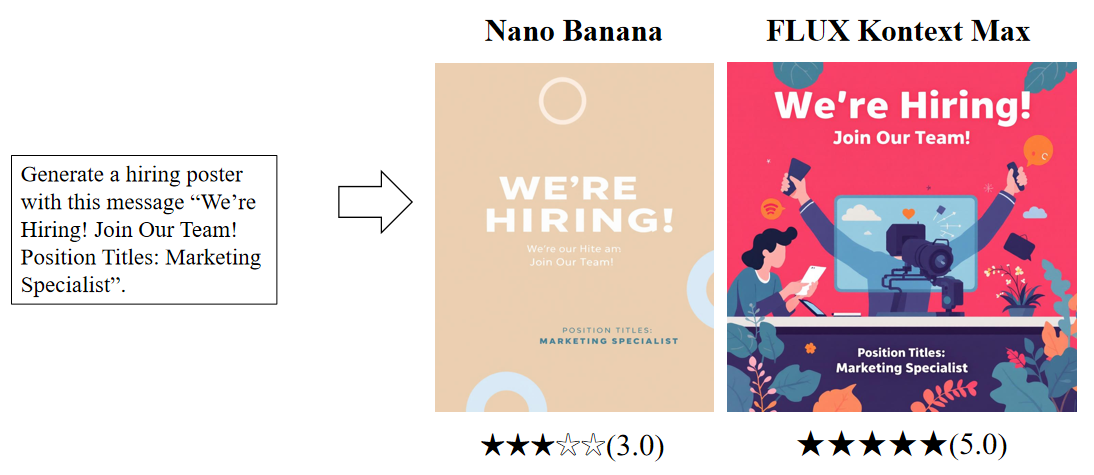
Real test:

  • Recruitment poster

Enter a prompt and generate a hiring poster with clean typography for the job details and consistent brand style. Flux Kontext Max makes sure that the words are readable and well-placed. It outperforms Nano Banana in typography.

8. Photorealistic Output Quality

Nano Banana: ★★★★★(5.0)

FLUX Kontext Max: ★★★★☆(4.0)

How they work:

  • Nano Banana delivers photorealism results with advanced detail enhancement. But FLUX Kontext Max is less refined. So Nano Banana is better.
  • Google Nano Banana AI generator stands out with photorealistic output quality. It delivers superior detail enhancement and high resolutions.
  • FLUX Kontext Max performs adequately but lacks Nano Banana’s advanced super-resolution capabilities.

Real test:

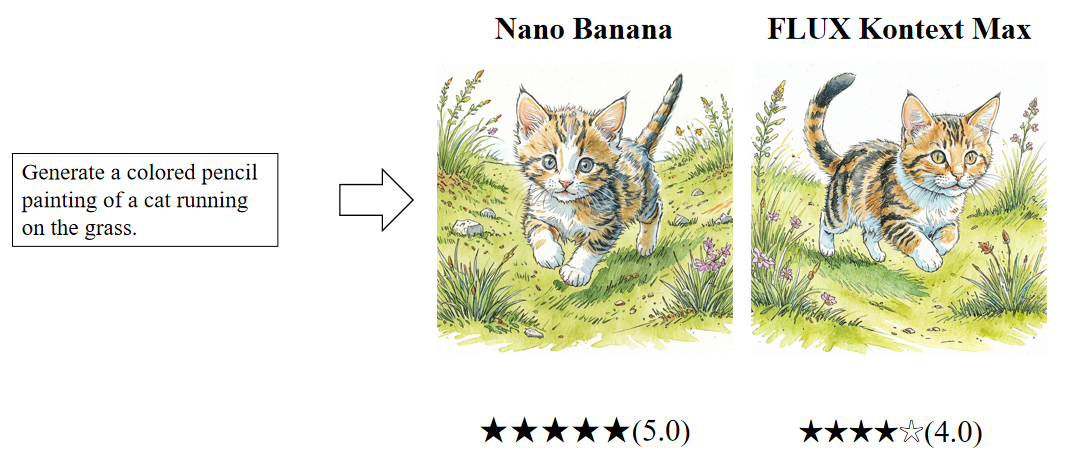
  • Art creation

The two AI image generators captures every brush stroke and subtle shade offering high-resolution outcomes for printing or posts. But Nano Banana has obvious advantage in image quality.

9. Multiple Platform Support

Nano Banana: ★★★☆☆(3.0)

FLUX Kontext Max: ★★★★★(5.0)

How they work:

  • Nano Banana is limited in platform support. But FLUX Kontext Max widely integrated. So FLUX Kontext Max is better.
  • Google Nano Banana AI generator is still mostly in research and experimental stages, so it’s less ready for large-scale professional workflows.
  • FLUX Kontext Max is built for workflow efficiency and commercial stability. It has integrated smoothly with industries like e-commerce, gaming, and advertising.

Real test:

  • Third-party integrations

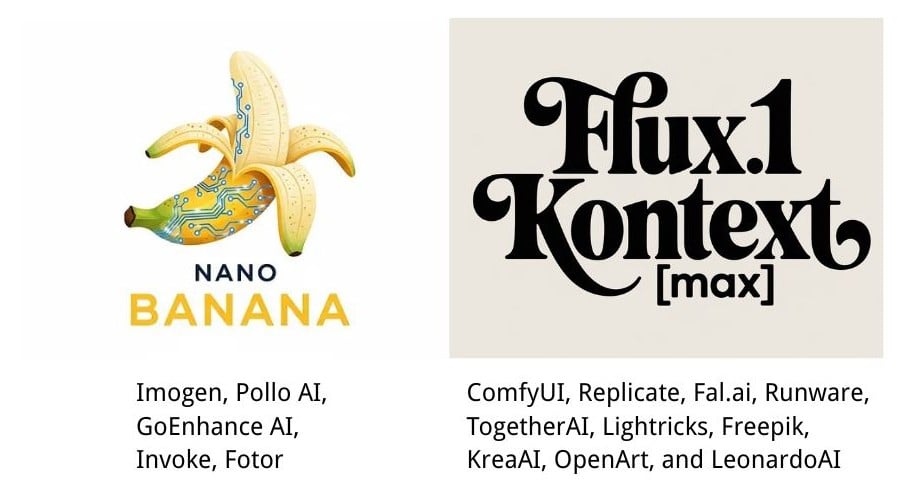
FLUX Kontext Max has more platform supports than Nano Banana.

Nano Banana: Imogen, Pollo AI, GoEnhance AI, Invoke, Fotor

Flux Kontext Max: ComfyUI, Replicate, Fal.ai, Runware, TogetherAI, Lightricks, Freepik, KreaAI, OpenArt, and LeonardoAI

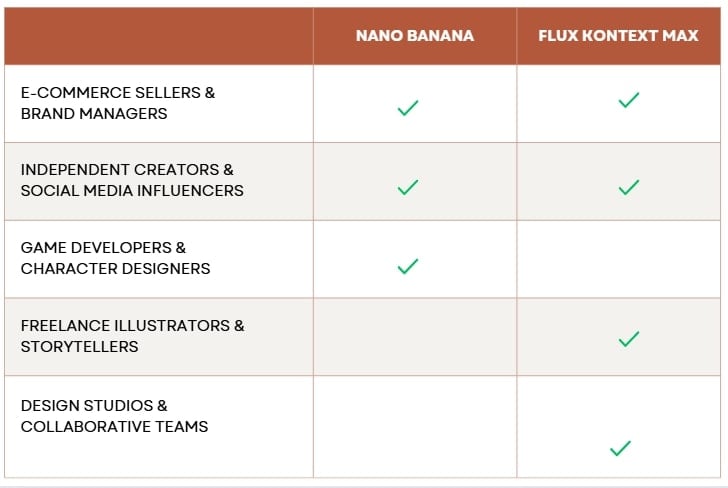
Who Benefits Most?

After looking at their capabilities and application scenarios, it’s clear that different groups will find different strengths in each model.

Choose Nano Banana if you're an s-commerce seller, an independent creator, or a game developer.

FLUX Kontext Max is a better idea for brand managers, social influencers, illustrators, and studios & teams.

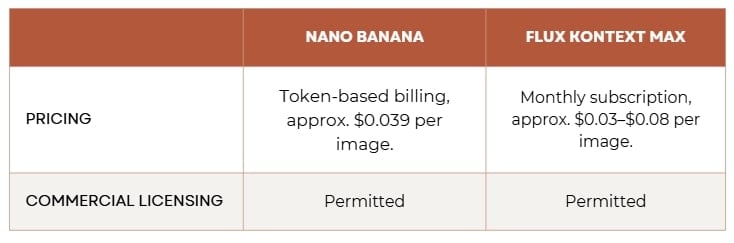
Pricing & Commercial Licensing at a Glance

Once you know which model fits your use case, the next question is cost. The table below outlines the pricing models and commercial licensing. So you can make a more informed decision.

Limitations and Challenges

Even the best AI tools come with a few drawbacks. Below is a brief overview of the main limitations of each model.

Nano Banana's Drawback

Nano Banana sometimes has access problems, like suddenly switching to another version. For professionals who need consistent, uninterrupted editing, this can be a real headache.

FLUX Kontext Max's Shortcoming

FLUX Kontext Max sometimes struggles during very long editing sessions. Too many rounds of local editing may introduce subtle artifacts, slightly reducing overall photorealism quality.

FAQs

Is there any free alternative to Nano Banana & FLUX Kontext?

Yes. Fotor’s AI image generator is a free alternative to Nano Banana & FLUX Kontext. It integrates the two powerful models and is free to use.

How can I access Nano Banana & FLUX Kontext?

You can access Nano Banana through Google’s Gemini app. And you can visit flux-ai.io to use FLUX Kontext Max directly.

For better experience, try Fotor’s AI image generator which integrates the two models on one platform.

Is Nano Banana better than FLUX Kontext?

Nano Banana is faster and easier to use, while FLUX Kontext offers more precise control and professional features. So which is better depends on your needs.

Conclusion

In this article, we compared Nano Banana and Flux Kontext Max, outlining their unique strengths, practical applications, and user fit. I've provided both intuitive graphics and detailed text analysis during my comparison. Rather than declaring a winner, the comparison shows that each model serves different creative needs.

Looking ahead, tools like these mark just the beginning of a broader transformation in the AI industry. The future promises not only higher efficiency, but also a new era of human–AI collaboration where imagination is the only real limit.